Larven Wants to Be Your AI CMO, Not Another AI Ad Generator
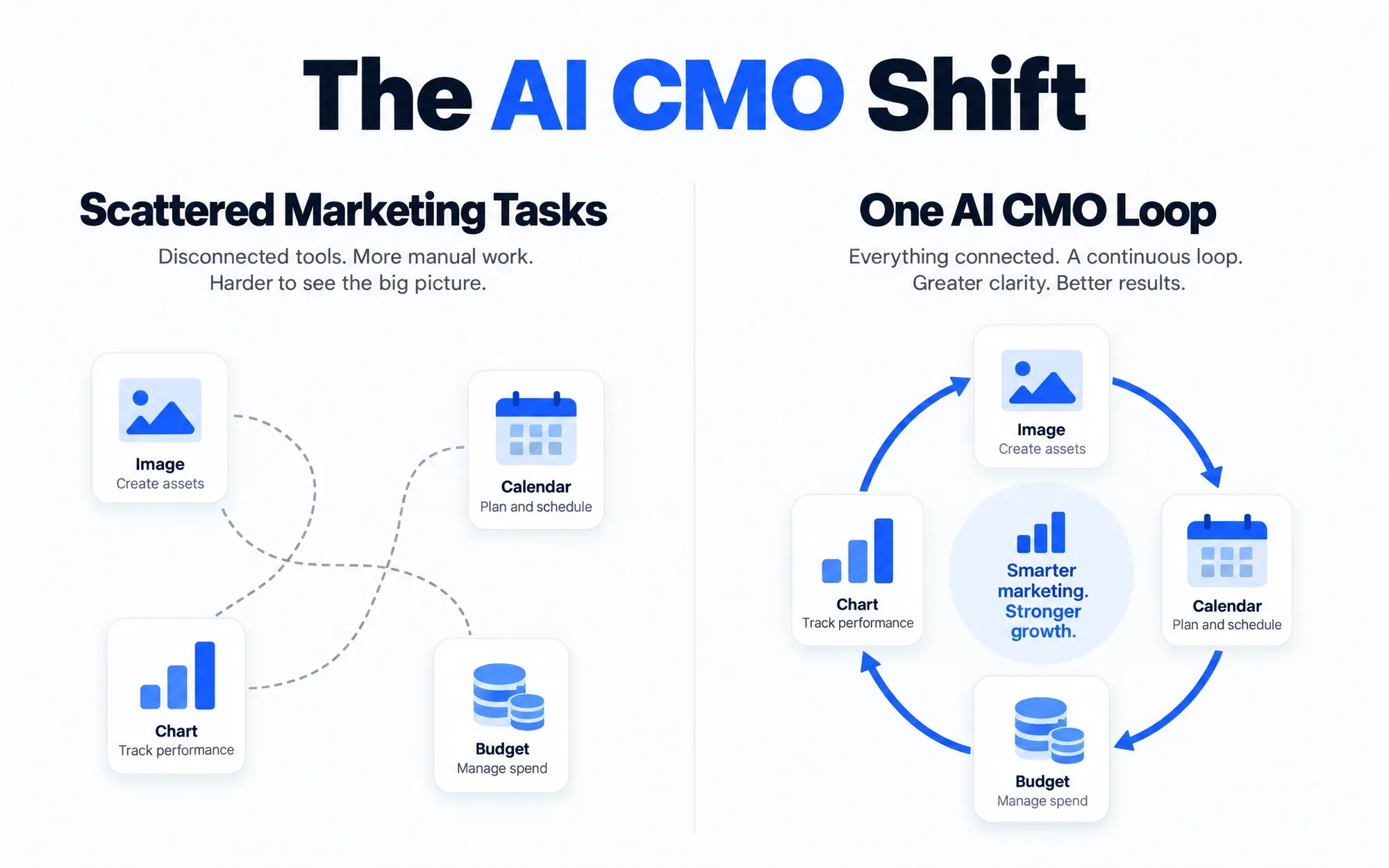
Generative AI has made ad creative cheap. A Shopify store can now produce fifty image ads before lunch. The hard part has moved somewhere else: deciding which of those fifty go live, reading what they did, killing the losers before they eat the budget, and making the next batch better than the last. Most AI ad tools stop at the first step and hand the rest back to a person.
Larven is built around the opposite bet. Instead of a faster ad generator, it pitches itself as an AI CMO: software that plans a campaign, makes the creative, launches it on the brand's own Meta ad account, reads the results every day and moves budget toward what sells. The creative is the input. The loop is the product.
Why Creative Volume Became the Bottleneck
Paid social has changed under advertisers' feet. Meta's ad system now leans on machine learning to decide who sees what, and the platform says the shift is only accelerating. In its engineering write-up of Andromeda, the retrieval engine that picks candidate ads, Meta notes that with generative AI tools for creating ad content, the number of ad creatives in its recommendation systems is expected to grow significantly.
For an advertiser, that has a practical consequence. Targeting is increasingly automated, so the creative itself carries more of the work of finding the right buyer. Running three ads for six weeks is no longer a strategy. Brands need a steady flow of genuinely different concepts, and a way to tell quickly which ones deserve the money.

That is a workflow problem more than a design problem. Generating the ad takes seconds. Briefing it, uploading it, structuring the test, checking it daily and acting on the numbers is what eats a small team's week.
What Larven Actually Does
Larven connects to a store (Shopify, WooCommerce or a custom catalogue) and to the brand's Meta account, then runs a five-step cycle on a daily cadence:
- Plans the campaign. It reads the product catalogue, past winners and audience, and builds the campaign structure in the brand's own ad account.
- Makes the creative. It generates fresh image and video ads from the products and brand kit, so the account is never leaning on one tired creative.
- Launches and tests. New ads go into testing without an export or re-upload step.
- Moves the budget. Ads that are not returning get paused, and spend shifts toward the ones that sell, inside a daily cap the brand sets.
- Reports what changed. Every action is logged, so the account stays auditable rather than becoming a black box.
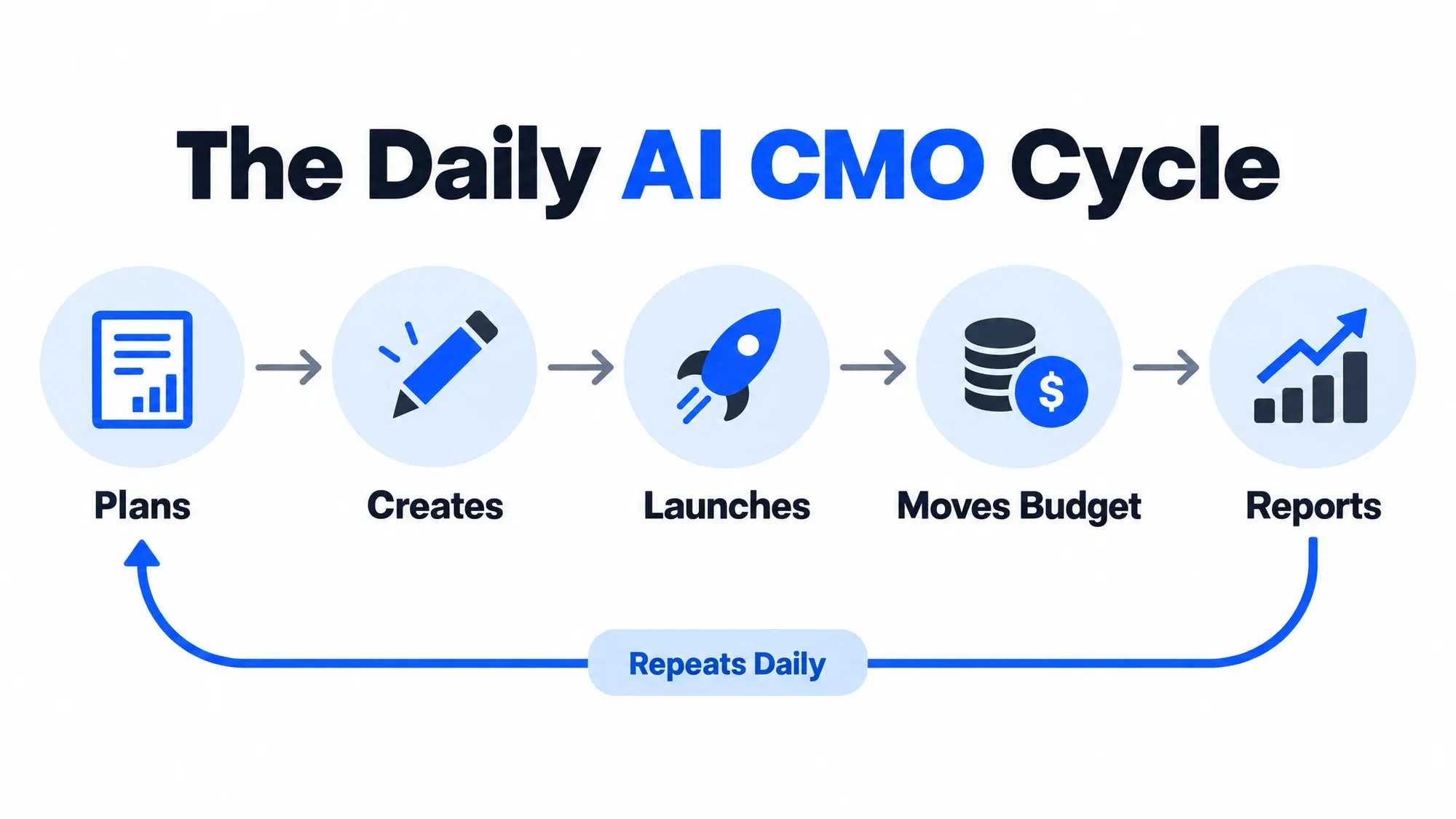
Then the cycle starts again, with yesterday's results as today's brief. The company's argument is that this cadence is the point: a weekly agency report reacts to creative fatigue days after it has already cost money.
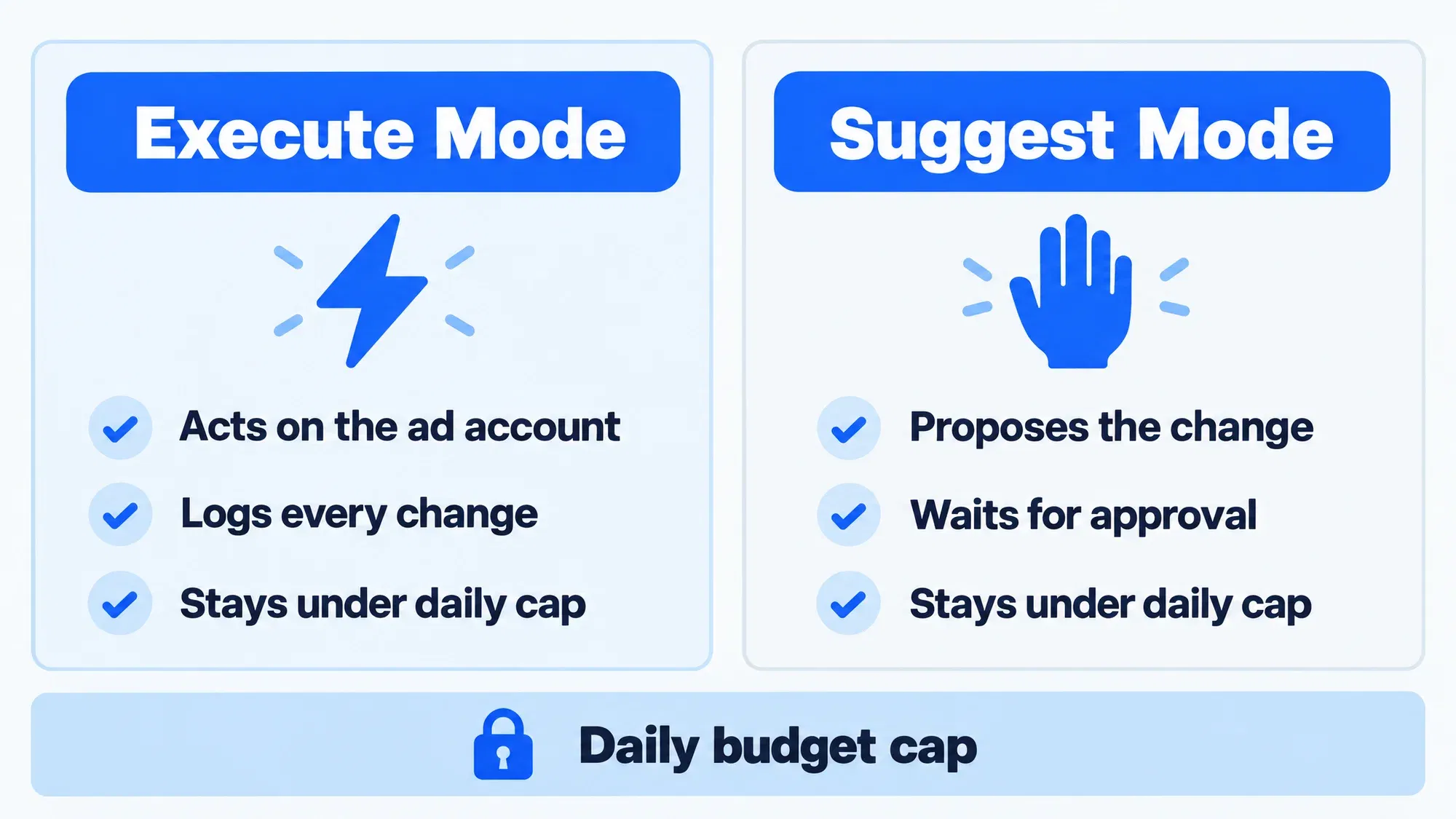
Brands choose how much control to hand over. In execute mode the system acts and logs every change. In suggest mode it proposes the same changes and waits for approval. In both, it cannot spend past the daily budget cap, and any single ad can be paused by hand without stopping the campaign.
The Creative Engine Underneath
The loop only works if the creative keeps coming, and this is where most of Larven's feature surface sits. Brands work from one brand kit, so every output shares the same colours, fonts and tone. From there the platform produces:
- Static ads in dozens of variations from a single product and brief.
- AI UGC videos from a library of more than 1,000 AI actors, plus product placement scenes where a presenter holds the item.
- Video from existing footage. Brands upload clips they already have, and Larven cuts up to five new edited ads from them.
- Service animations that turn real photos of finished work into motion ads, aimed at local service businesses rather than stores.
- Localisation into more than 30 languages and resizing for Reels, Stories, Shorts and feed placements without re-shooting.

Around that sit tools a marketing lead would otherwise buy separately: competitor ad tracking per brand, social scheduling across channels, and article and email builders. The breadth is deliberate. The pitch is that one system holding the brand's data, creative history and performance numbers makes better calls than five tools that never talk to each other.
Where an AI CMO Fits Against the Alternatives
Larven frames the decision as a comparison of cost and cadence rather than of output quality alone:
| Option | Typical cost | Cadence | What it covers |
|---|---|---|---|
| AI CMO (Larven) | Subscription | Daily, automatic | Creative, launch, testing, budget |
| Agency | Retainer plus a share of spend | Weekly, in a meeting | Everything, at their pace |
| Freelance media buyer | Retainer or day rate | A few hours a week | Buying, usually no creative |
| In-house hire | A salary | Full time | Everything, one person |
| Standalone ad generator | Cheaper subscription | When someone opens it | Creative files only |
The comparison is fair to the alternatives in one respect worth noting: Larven does not claim to replace strategy. Its own documentation says plainly that it does not set pricing, positioning or the offer, cannot know about a supplier problem nobody fed into the data, and is not instant. Meta needs conversions before delivery settles, so the first weeks are learning rather than steady state. Plenty of brands run it alongside an agency, using it to multiply creative tests while the agency keeps the strategic work.
Who It Suits
The clearest fit is a lean ecommerce team spending real money on Meta without the headcount to feed it. A founder who currently briefs a freelancer, waits a week for ads, and then checks Ads Manager at midnight is the user the product is designed around. Agencies managing many small accounts are a second audience, since one workspace holds several brand kits.
It is a weaker fit for brands whose advertising is mainly search, for companies that need every ad through a long legal review, and for anyone expecting software to rescue an offer the market does not want.
Pros and Cons
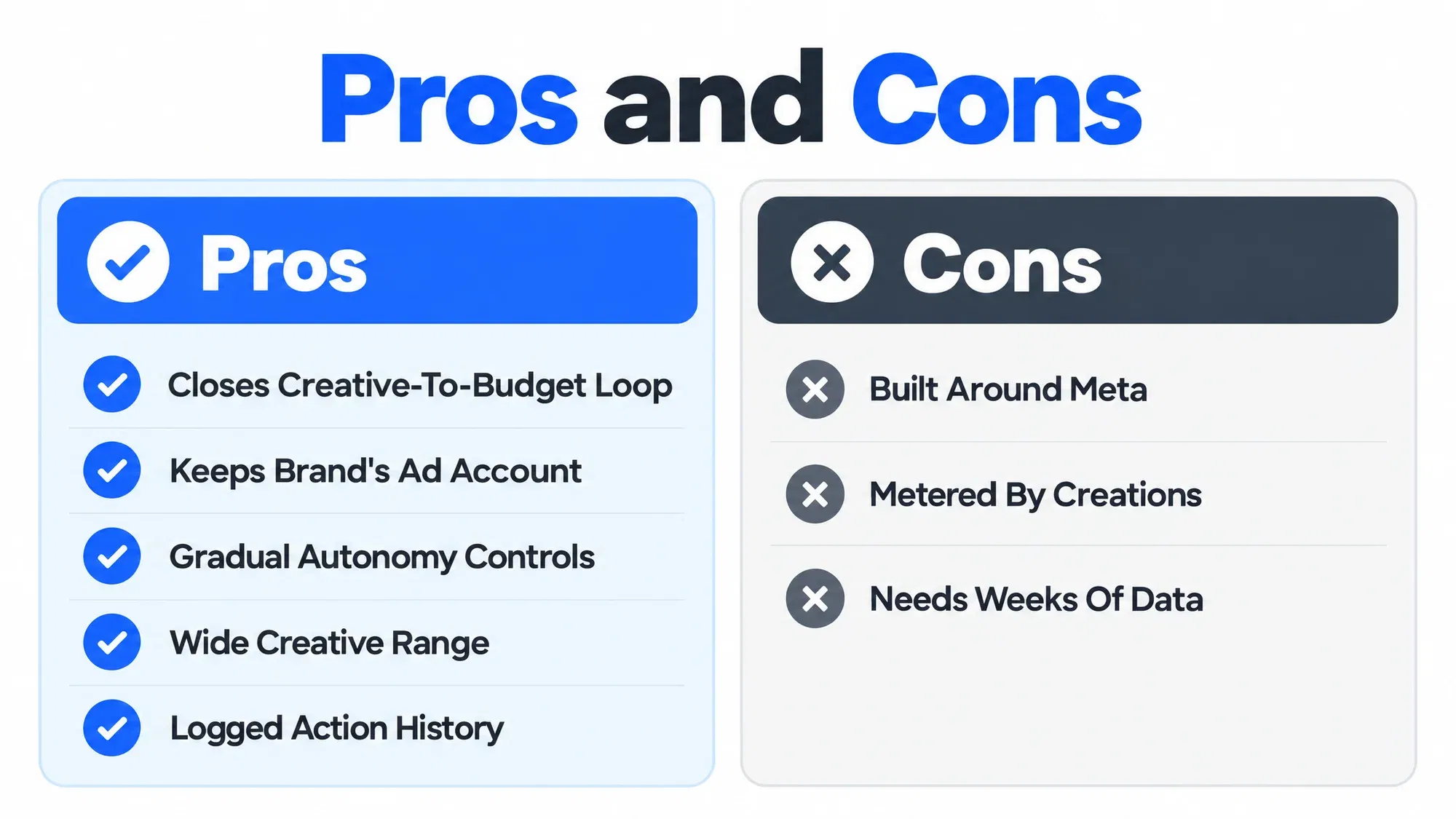
Pros
- Closes the loop from creative to budget, instead of stopping at a downloaded file.
- Runs on the brand's own Meta ad account, so pixel history and audiences stay with the brand.
- Suggest mode and a hard daily cap make autonomy something a brand can grant gradually.
- Wide creative range from one brand kit: statics, AI UGC, edits of existing footage and localisation.
- A logged action history, which makes automated decisions reviewable after the fact.
Cons
- The autonomous loop is built around Meta. Teams whose main channel is elsewhere will use it more as a creative tool.
- Output is metered by monthly creations, so video-heavy teams should check which tier matches their volume.
- Like any system that learns from conversions, it needs a few weeks of data before its budget calls carry weight.
Pricing
Larven offers a free trial with no card required. Paid plans are tiered by monthly creations and the number of brands: at the time of writing, Starter includes 125 creations a month and one brand kit, Scale 325 creations and three brand kits, and Pro 1,250 creations and ten brand kits. Prices vary by region and billing period, so the current figures are best checked on Larven's site.
The Bigger Shift
The first wave of AI marketing tools competed on how good a single generated ad could look. That race is close to settled: most tools can now make a competent product ad. The next contest is about what happens after the ad exists, and whether software can be trusted to act on results rather than just report them.
Larven's answer is to make the whole loop the product, keep a human able to veto any step, and log everything it does. For small teams running Meta ads on thin margins, that is a more useful promise than another gallery of pretty creatives.
FAQ About Larven
What is Larven?
Larven is an AI marketing platform that works as an AI CMO for ecommerce and service brands. It generates image and video ads from a brand's products, launches them on the brand's Meta ad account, and shifts budget toward the ads that sell.
Is Larven just an AI ad generator?
No. It does generate ads, but its focus is the loop after generation: launching, testing, pausing underperformers and reallocating budget daily, with every action logged.
Can Larven change my ad account without approval?
Only if you allow it. In execute mode it acts and logs each change; in suggest mode it proposes changes and waits for approval. In both modes it stays inside the daily budget cap you set.
Which platforms does Larven work with?
It connects to Shopify, WooCommerce and custom catalogues, and publishes ads to Meta and TikTok. The autonomous campaign management runs on Meta.